SEARCHING | Ascaso Gallery | Miami
SEARCHING | Ascaso Gallery
SEARCHING | Ascaso Gallery
Customized by CORREA 100% made by VANS
Customized by CORREA 100% made by VANS
VIRTUAL OVERLOOK | 2007 - 2011


2002 is the year From Chaos to Flowers becomes a body of work, and the year the practice leaves the canvas.
The series had begun in November 2001, on leftover canvas in Long Island City, when a stain circled in charcoal read as a flower. A few paintings were finished then. Most were made in 2002. The question is not new. It is the question after a break. In 2000 the work had asked what persons share. In 2001 that asking seemed to have failed, and the decision had been to stop. What remained was the flower: not a program, a mark that had kept the hand moving. Across 2002 that mark is painted as a way of going on. Healing is part of it. Hope is part of it. Neither cancels the year before. The figure of Personajes and of Celebrating Mythology is no longer the subject of the paintings. The flower is. It has not left the work since.
The same year the work left the flat surface. These pieces are three-dimensional paintings more than installations. The first was Proyecto Quinta La Calle. A house was built of wood panels. The outside was painted with personajes made to resemble people who live in the street. The inside was white. Markers hung from the ceiling. Above each entrance, in white lettering, was the question ¿Cuánta limosna hace falta para no ver la miseria a los ojos? (How much charity does it take not to see misery in the eyes?). Visitors wrote on the walls what they thought, what they had lived, what they wanted to write. The walls had been left clean for that. The piece was a painting that could be entered. The people who came in were part of it. The house was built three times: in Venezuela, in the United States, and in Singapore.
After it came El Premio Más Preciado. The title is in Spanish. It was a large gift box. On the walls, a life was written as a sequence of wants: a toy car, then the next thing, a college degree, a house, children, a family. No one was asked to write. The visitor walked a small labyrinth and passed a curtain into a black room. A light came on. The text read, Congratulations, this is your most precious gift. What the light showed was a full-length mirror. The exit was on the other side.
The series of flowers does not close in December 2002. The flower stays in the practice. Proyecto Quinta La Calle and El Premio Más Preciado open the other line: the work that is built, and that is finished by the person who enters it.
The numbers in the flower titles were given when the first group of the series was finished, not as each canvas was painted. A number is a name. It is not the order of the work. Only the year was certain.
2002 es el año en que From Chaos to Flowers se vuelve un cuerpo de obra, y el año en que la práctica sale del lienzo.
La serie había empezado en noviembre de 2001, sobre lienzo sobrante en Long Island City, cuando una mancha rodeada con carboncillo se leyó como una flor. Entonces se terminaron unas pocas pinturas. La mayoría se hizo en 2002. La pregunta no es nueva. Es la pregunta después de una ruptura. En 2000 la obra había preguntado qué comparten las personas. En 2001 esa pregunta pareció haber fallado, y la decisión había sido parar. Lo que quedó fue la flor: no un programa, una marca que había mantenido la mano en movimiento. A lo largo de 2002 esa marca se pinta como una forma de seguir. La sanación es parte. La esperanza es parte. Ninguna anula el año anterior. La figura de Personajes y de Celebrating Mythology ya no es el tema de las pinturas. La flor lo es. No ha salido de la obra desde entonces.
El mismo año la obra dejó la superficie plana. Estas piezas son pinturas tridimensionales más que instalaciones. La primera fue Proyecto Quinta La Calle. Se construyó una casa de paneles de madera. El exterior se pintó con personajes hechos a semejanza de quienes viven en la calle. El interior era blanco. Del techo colgaban marcadores. Sobre cada entrada, en letras blancas, estaba la pregunta ¿Cuánta limosna hace falta para no ver la miseria a los ojos? Quienes entraban escribían en las paredes lo que pensaban, lo que habían vivido, lo que querían escribir. Las paredes se habían dejado limpias para eso. La pieza era una pintura a la que se podía entrar. Quienes entraban formaban parte de ella. La casa se construyó tres veces: en Venezuela, en Estados Unidos y en Singapur.
Después vino El Premio Más Preciado. El título está en español. Era una gran caja de regalo. En las paredes, una vida estaba escrita como una secuencia de deseos: un carro de juguete, luego lo siguiente, un título universitario, una casa, hijos, una familia. A nadie se le pedía escribir. El visitante recorría un pequeño laberinto y pasaba una cortina hacia un cuarto negro. Se encendía una luz. El texto decía: Felicitaciones, este es tu premio más preciado. Lo que la luz mostraba era un espejo de cuerpo entero. La salida estaba del otro lado.
La serie de las flores no se cierra en diciembre de 2002. La flor permanece en la práctica. Proyecto Quinta La Calle y El Premio Más Preciado abren la otra línea: la obra que se construye, y que termina quien entra en ella.
Los números de los títulos de las flores se pusieron cuando el primer grupo de la serie estuvo terminado, no al pintarse cada lienzo. Un número es un nombre. No es el orden de la obra. Solo el año era seguro.
From Chaos to Flower #6, 2002, 27 x 21.8 in (68.6 x 55.3 cm), acrylic on canvas


From Chaos to Flower #8, 2002, 23.3 x 27 in (59.2 x 68.6 cm), acrylic on canvas

From Chaos to Flower #3, 2002, 20.6 x 27.5 in (52.4 x 69.9 cm), acrylic on canvas
From Chaos to Flower #10, 2002, 30 x 22.5 in (76.2 x 57.1 cm), acrylic on canvas
Proyecto Quinta La Calle, 2002, acrylic on wood and Sharpie markers. (outdoor view)


From Chaos to Flower #12, 2002, 19.9 x 28 in (50.5 x 71.1 cm), acrylic on canvas


Proyecto Quinta La Calle, 2002, acrylic on wood and Sharpie markers. (indoor view)
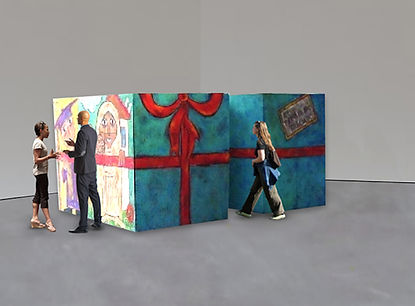
El Premio Mas Preciado, 2002, acrylic on wood, light, and mirror
El Premio Más Preciado, 2002. Scale reference.
The structure was damaged by water in transit from Caracas to Miami and does not survive.
Acrylic on wood panels.
El Premio Más Preciado, 2002. Referencia de escala.
La estructura se dañó con agua en el traslado de Caracas a Miami y no se conserva.
Acrílico sobre paneles de madera.